
Dont Trouble The Trouble Movie Review: Fahadh Faasil makes this fantasy comedy watchable
An unusual fantasy premise, natural performances and situational humour keep the film engaging, although the lengthy second half limits its overall impact.
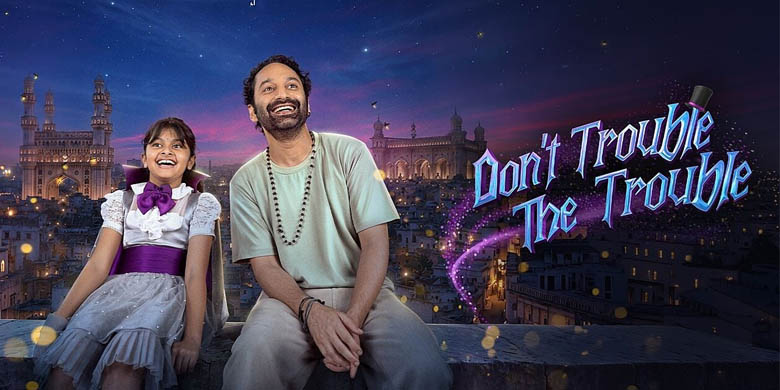
Dont Trouble The Trouble Movie Review
Fahadh Faasil lifts this fantasy comedy
Performances
Story & Narration
Technical Aspects & Music
Dont Trouble the Trouble is a fantasy comedy that brings together Fahadh Faasil and young Ssara Palekar for an unusual adventure. The story follows Suri, an orphan who is obsessed with making quick money. His latest attempt to escape a financial crisis leads him to Divya, a young girl with mysterious powers. What begins as a simple plan soon turns into an unexpected journey filled with fantasy, humor and emotion.
Suri is an ambulance driver who believes that money can solve almost every problem in life. His habit of cheating people eventually puts him in serious trouble with Aslam Bhai, a dangerous moneylender. He is given a short deadline to arrange 25 lakh. With no easy way out, Suri sees an opportunity in Divya, who comes from a wealthy family. However, the girl is not what she appears to be. Their journey slowly reveals the strange truth behind her identity and changes Suri’s life in ways he never expected.
The first half is the film’s more enjoyable portion. Shashank Yeleti takes time to establish Suri’s character before bringing Divya into the story. Once the two characters come together, the film finds a better rhythm. Suri’s reactions to Divya’s unusual abilities create several amusing situations. The contrast between his selfish nature and her innocent behaviour also gives the comedy a natural base. The film does not depend entirely on loud humour. Instead, several situations work because of Fahadh’s expressions and the strange circumstances surrounding the pair.
The relationship between Suri and Divya gradually becomes the emotional centre of the film. Their journey gives Suri an opportunity to look beyond his obsession with money. The film also finds some warmth in their combination scenes. The fantasy elements add curiosity to their adventure, while the mystery surrounding Divya keeps the story moving. The interval portion creates a useful shift in the narrative and gives the second half a clear direction.
However, the second half does not maintain the same momentum. The story becomes more focused on the emotional consequences of Divya’s situation, but the screenplay takes too long to reach its destination. The police track and some repetitive situations slow down the proceedings further. Several scenes also feel stretched when the story should have moved towards the climax. The emotional portions have good intentions, but they do not always create the desired impact. The final stretch does offer a few touching moments, though the lengthy treatment reduces their effectiveness.
Fahadh Faasil remains the biggest strength of the film. He brings a relaxed comic quality to Suri and makes the character entertaining even when the writing becomes predictable. His dialogue delivery feels natural, and his expressions add personality to several ordinary scenes. Ssara Palekar is also convincing as Divya. She brings innocence to the character and handles the emotional moments with sincerity. The chemistry between Fahadh and Ssara gives the film much of its warmth. Mahesh Manjrekar makes an impression in his limited role, while Venkatesh Kakumanu adds some support as Suri’s concerned friend. Saurabh Sachdeva and the remaining actors are adequate within their respective parts.
Kaala Bhairava’s background score adds energy to the lighter portions and supports some of the emotional scenes. However, the music does not leave a lasting impact. Brad Francis’ cinematography is more effective, particularly in the outdoor portions and during the journey involving Suri and Divya. The visuals give the fantasy setting a pleasant quality without becoming overly elaborate. Praveen Antony’s editing could have been tighter, especially in the second half. Several scenes could have been trimmed to make the narrative more engaging.
Don’t Trouble the Trouble has an interesting basic idea and finds its best moments when it focuses on the unusual relationship between Suri and Divya. The first half offers enjoyable situational humor, while Fahadh Faasil and Ssara Palekar keep the central journey watchable. However, the second half loses pace and struggles to build enough emotional weight. The screenplay also needed sharper writing and tighter editing to make the fantasy elements more effective. Still, the performances and a handful of entertaining sequences make the film a reasonably engaging one-time watch.
Dont Trouble The Trouble Movie Rating: 3/5