
Baththa Movie Review: Balaji Tharaneetharan strikes gold with humor, emotions and humanity
Baththa turns a simple gangster premise into an engaging tale of friendship and redemption, powered by Vijay Sethupathi, young Sabari and soulful music.
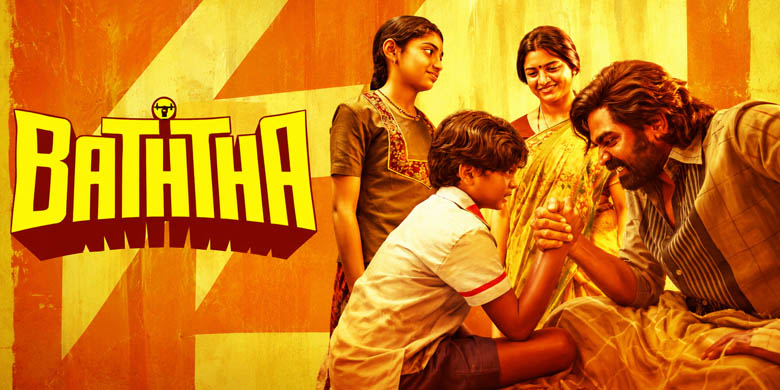
Baththa Movie Review
A gangster tale with plenty of heart
Performances
Story & Narration
Technical Aspects & Music
Baththa takes an unusual route with its gangster story. Set in 1986 Madras, the film follows a feared local don who is accidentally locked inside a deserted school restroom by an eight year old boy. What begins as a funny predicament gradually becomes an unexpected bond between two people from completely different worlds. Balaji Tharaneetharan uses this simple setup to explore friendship, family and redemption while keeping the film consistently entertaining.
The film takes some time to get going as the opening portions establish the characters and the situation. Once Baththa gets trapped inside the school, however, the film finds its rhythm. The humor comes from seeing a feared gangster stuck in such an ordinary situation. At the same time, the writing never reduces him to a comic character. There is a genuine emotional core beneath the comedy, and the relationship between Baththa and the boy slowly becomes the driving force of the narrative.
The first half picks up considerably after the initial setup and builds towards a well-earned interval. The school portions are among the most enjoyable parts of the film, with Balaji Tharaneetharan finding humor in small situations instead of depending on forced comedy. Vijay Sethupathi’s effortless performance adds to these sequences, while young Sabari holds his own remarkably well. The screenplay also knows when to shift gears, and the interval block gives the story a strong dramatic turn.
The second half is where Baththa finds its emotional strength. What starts as an entertaining relationship gradually becomes more personal as Baththa’s family and past come into focus. The writing handles this transition without making the film unnecessarily heavy. The humor continues to exist alongside the emotional moments, keeping the film’s tone consistent. Several seemingly simple incidents gain greater significance as the story progresses. The final 30 minutes then bring the different emotional threads together with considerable warmth and impact.
Vijay Sethupathi is excellent as Baththa. He brings the swagger needed for a gangster but is equally convincing when the character’s vulnerable side begins to emerge. His performance becomes more restrained as the film moves into its emotional portions, making those scenes more effective.
The biggest surprise, though, is young Sabari, who is terrific throughout. His expressions, timing and natural screen presence make him an ideal match for Vijay Sethupathi. Their chemistry becomes the soul of the film. Lijomol Jose is also very good, bringing warmth and credibility to the family portions, while the supporting cast fits neatly into the narrative.
On the technical front, Sai Abhyankkar’s music and background score are a major asset. His score has a distinctive quality that suits the film’s combination of gangster elements, humor and emotion. It never feels like it is competing with the narrative. Instead, it enhances the mood of the important sequences. Selva Kumar’s cinematography effectively captures the period setting and gives the film an appropriate visual texture. More than anything, it is Balaji Tharaneetharan’s screenplay that holds the film together. He extracts entertaining moments from small incidents and gradually connects them to Baththa’s larger emotional journey.
Baththa works because it gives us something different from what its gangster premise promises. It has gangs, humor and action, but its real strength lies in the unlikely friendship at its centre. The first half takes some time to settle before becoming highly engaging, while the second half adds the emotional weight that makes the journey satisfying. Vijay Sethupathi and Sabari make for a wonderful combination, and the film’s ability to move naturally between laughter and emotion is one of its biggest strengths. Atlee and the team also deserve credit for backing a film that gives Balaji Tharaneetharan the space to tell this story in his own style. The result is a warm, refreshing and thoroughly enjoyable theatrical experience that leaves you with a smile.
Baththa Movie Rating: 4/5