
Parasakthi Movie Review: A fierce, emotionally charged political drama rooted in linguistic identity
Set against the 1960s student uprisings, Parasakthi examines linguistic identity, resistance and sacrifice through an emotionally charged political narrative rooted in rebellion and unity. Here goes our Parasakathi Movie Review.
Parasakthi Movie Review
Student revolution told with conviction
Performances
Story & Narration
Technical Aspects & Music
Parasakthi, directed by Sudha Kongara, is a fictional yet strongly grounded political drama inspired by the student-led movements of the 1960s that opposed Hindi imposition in Tamil Nadu. While the narrative does not recreate real events, it captures the emotional, ideological, and societal turmoil of that era with conviction. At its core, the film speaks about the importance of regional languages across India and the cost paid by students who stood united for linguistic identity.
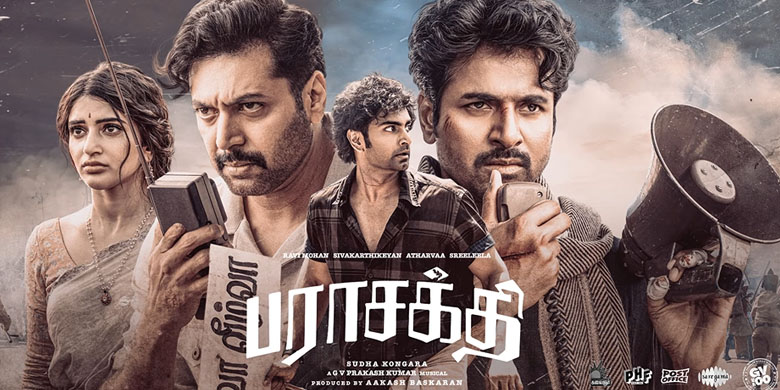
Sivakarthikeyan plays Chezhiyan, the leader of a revolutionary student force named Purananooru, which actively protests against Hindi imposition that disrupts the everyday lives of Tamil people. A tragic incident within the movement forces Chezhiyan to abandon the revolution and retreat into a quieter, family-oriented life, setting the stage for a layered, emotionally driven narrative.
The film opens with an exceptionally strong opening stretch that immediately establishes the political tension and revolutionary spirit of Purananooru. The first 15 minutes stand out for their intensity and clarity of purpose. Soon after, the narrative shifts five years ahead, showing Chezhiyan living a subdued life, burdened by the past.
Atharvaa is introduced as Chezhiyan’s younger brother – an engineering student with strong rebellious ideals, unaware that the mysterious leader he looks up to is his own sibling. Sreeleela enters as a politically backed, Telugu-speaking family friend and Atharvaa’s partner in rebellion. Her character subtly reinforces the film’s message that linguistic pride does not equate to linguistic hatred. The pre-interval portion steadily gains momentum, culminating in a hard-hitting sequence that leads to a powerful interval block, marking one of the film’s strongest stretches.
The second half unfolds as an intense cat and mouse chase between Chezhiyan, Atharvaa, and Ravi Mohan’s antagonist. Ravi Mohan plays a ruthless, authoritative cop who strongly supports Hindi imposition and operates on his own moral compass. This phase of the film effectively portrays the struggles, sacrifices, and loss of lives during student-led protests.
The narrative remains focused and emotionally charged, closing with a resonant climax filled with “Tamil Vaazhga” (தமிழ் வாழ்க) chants that underline the film’s ideological spine. The ending reinforces that Parasakthi is not about opposing a language, but about preserving linguistic dignity within each state.
Parasakthi marks one of the finest performances of Sivakarthikeyan’s career. He excels as a fierce revolutionary, a conflicted brother, a gentle family man, and a commanding protagonist. His emotional range is a major strength of the film.
Ravi Mohan, in his first-ever antagonist role, delivers a powerful and intimidating performance, backed by impactful dialogues. While he dominates his scenes, the character’s emotional arc feels slightly restricted, limiting its overall depth.
Atharvaa impresses as a rebellious student and delivers one of his best performances, especially in emotionally charged sequences. Sreeleela is decent for most parts but truly shines in the climax with a strong emotional payoff. Supporting actors perform effectively, with special mention to Chetan as Arignar Anna, who fits the role convincingly. Three special cameo appearances add pleasant surprises.
GV Prakash Kumar, celebrating his 100th film, delivers a compelling background score that significantly elevates the second half. Ravi K Chandran’s cinematography is top-class, particularly in staging, lighting, and framing. The production design by Karthik Rajkumar and art direction by Annadurai deserve special praise for authentically recreating the 1960s period.
With Parasakthi, Sudha Kongara takes a bold step forward in her filmography. Handling a politically sensitive subject within a period setup is no small feat, and she largely succeeds in balancing emotion, ideology, and cinematic scale. While the writing could have been sharper in places (possibly due to censor trims) the impact remains strong, especially in the opening, interval, and climax portions.
Overall, Parasakthi is rebellious, emotional, and impactful in many sequences. Despite minor writing limitations, it is a compelling watch for its powerful performances, strong technical execution, and its tribute to student unity and linguistic pride across the country.
Parasakthi Movie Rating: 3.5/5